
Running a single-member LLC often means doing everything yourself. You handle sales, invoices, expenses, taxes, customer payments, and the occasional late-night bookkeeping session.
Your bank account should make that work easier.
A personal checking account may appear sufficient when the business is small, especially if your LLC is treated as a disregarded entity for federal income tax purposes. But mixing personal and business transactions creates messy records. It becomes harder to identify deductible expenses, estimate taxes, explain transfers, and demonstrate that the LLC operates separately from your personal finances.
The best business bank account is not necessarily the one advertising the largest welcome bonus. A $300 bonus loses its value quickly when the account charges $15 per month, limits free transactions, or lacks the payment tools your business uses every week.
A consultant paid through ACH has different needs from a retailer depositing cash. An online startup sending international wires needs different features from a local contractor who wants branch support.
This ranking focuses on the issues that matter most to a solo LLC owner: monthly fees, minimum balances, transaction limits, cash deposits, interest, tax tools, invoicing, subaccounts, integrations, and deposit insurance.
Here are the first four of the seven best business bank accounts for single-member LLCs.
What Should a Single-Member LLC Look for in a Business Bank Account?
The first priority is separation.
The Small Business Administration recommends maintaining a business account so company funds remain separate from personal money. Banks commonly request an EIN or Social Security number, formation documents, ownership information, and relevant business licenses. A single-member LLC that does not otherwise require an EIN may still obtain one when it needs the number to open a bank account.
Our seven account picks
- Bluevine Business Checking: Best overall for earning interest with no standard monthly fee
- Chase Business Complete Banking: Best for branch access and cash deposits
- Found Business Banking: Best for built-in bookkeeping and Schedule C tax tools
- Mercury Business Banking: Best for startups and frequent wire transfers
- Relay Business Banking: Best for multiple accounts and cash-flow organization
- Novo Business Checking: Best for freelancers and online businesses
- Axos Basic Business Checking: Best for ATM reimbursements and incoming wires
Before opening an account, compare:
- True monthly cost: Include transaction, wire, cash deposit, ATM, and instant-transfer fees.
- How customers pay you: ACH, cash, check, card, marketplace payout, or wire.
- How you reserve taxes: A solo owner may need separate tax and operating buckets.
- Access requirements: Decide whether mobile banking is enough or whether you need a branch.
- FDIC structure: Confirm whether the provider is a bank or a fintech using an FDIC-insured partner bank.
Why it matters: The right account should match how money enters and leaves your LLC. A high APY is not useful when the account makes your daily transactions expensive or inconvenient.
1. Bluevine Business Checking: Best Overall for No-Fee Interest Checking
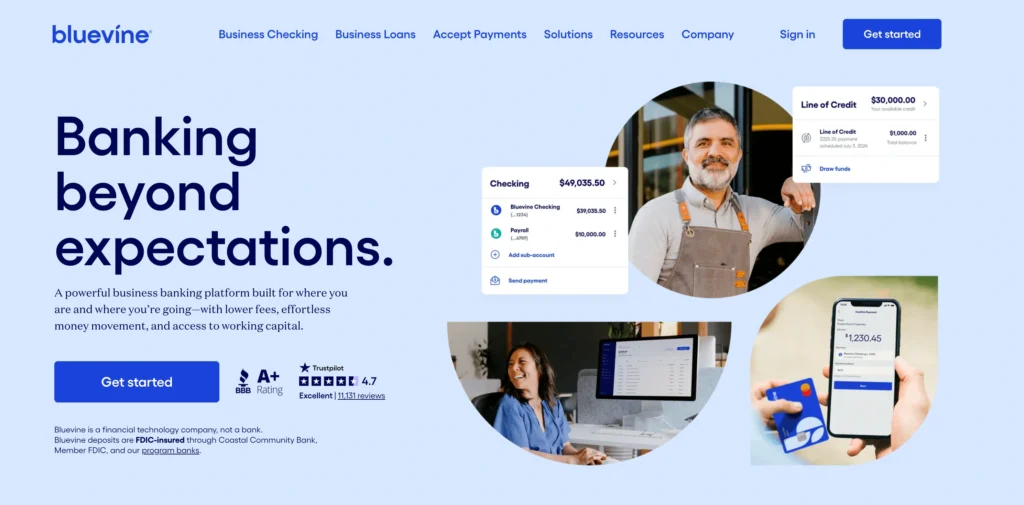
Bluevine Standard combines a $0 monthly fee with the ability to earn interest directly inside the operating account.
The Standard plan currently includes:
- No monthly maintenance or overdraft fee
- No minimum balance
- Unlimited transactions
- Free standard ACH transfers
- Up to five subaccounts
- Invoicing and payment links
- FDIC insurance eligibility of up to $3 million through Coastal Community Bank and Bluevine’s program banks
Standard customers can earn 1.3% APY on balances up to $250,000 by either spending at least $500 per month with the Bluevine business debit card or receiving or depositing at least $2,500 per month in qualifying customer payments. Bluevine also offers paid Plus and Premier plans with higher APYs and more subaccounts.
What the interest could mean in practice
Assume your LLC keeps an average operating balance of $25,000 and meets the monthly activity requirement.
At 1.3% APY, the account could earn approximately:
$25,000 × 1.3% = $325 per year
That will not transform the business, but it is better than leaving operating cash in a non-interest-bearing account while paying no monthly maintenance fee.
The subaccounts are also useful for a solo owner. You could divide the balance into:
- Operating expenses
- Quarterly taxes
- Owner’s pay
- Emergency reserve
- Future equipment
The main limitation
Bluevine is a fintech platform, not a traditional branch bank. It works best for LLCs receiving digital payments rather than businesses that need regular teller assistance or large cash deposits.
Why it matters: Bluevine is one of the strongest all-purpose choices for service businesses, consultants, agencies, and online companies that want low fees and interest without constantly transferring money into savings.
2. Chase Business Complete Banking: Best for Cash Deposits and Branch Access
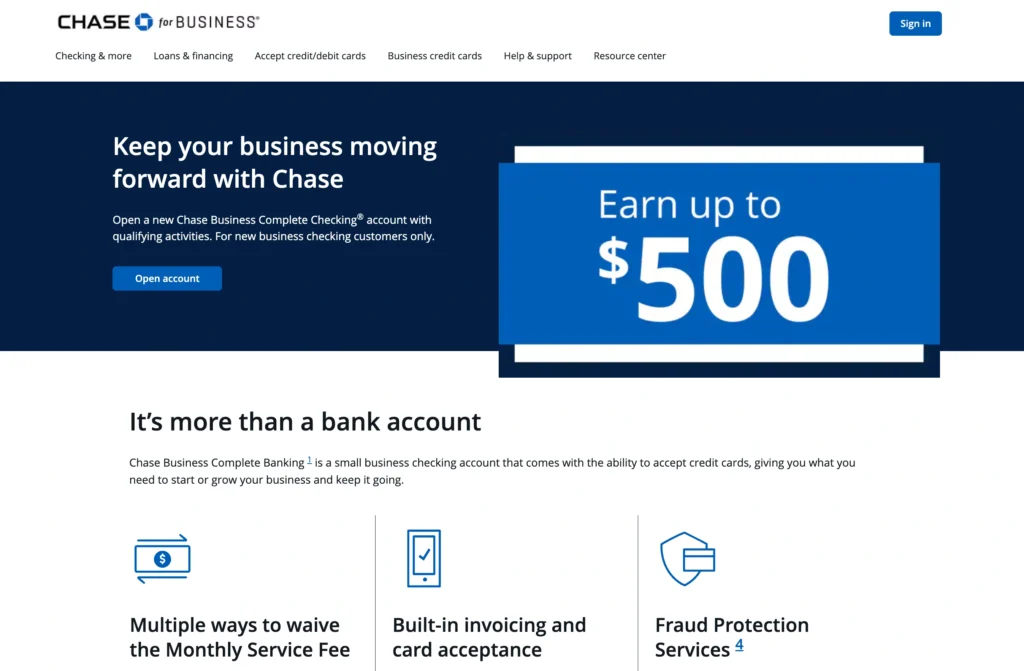
Chase Business Complete Banking is a better fit when your LLC handles cash, wants in-person service, or needs payment processing inside a traditional banking relationship.
The account has a $15 monthly service fee, but Chase offers several ways to waive it. These include maintaining a $2,000 minimum daily ending balance, receiving $2,000 in eligible Chase payment-processing deposits, or making $2,000 in eligible purchases with a qualifying Chase business credit card.
Each statement cycle also includes, at no additional charge:
- Up to $5,000 in in-branch cash deposits
- Up to 20 checks and certain banker-assisted deposits or withdrawals
- Unlimited electronic deposits
- Deposits at Chase ATMs
- Built-in invoicing and card acceptance through Chase QuickAccept
There is no minimum opening deposit, and eligible single-member or single-manager LLCs can apply online.
Run the fee calculation honestly
If you cannot satisfy a waiver condition, the account costs:
$15 × 12 months = $180 per year
That may still be reasonable for a bakery, mobile service provider, retailer, or local contractor depositing cash and visiting branches. For a consultant who receives two ACH payments per month and never handles cash, the fee may be unnecessary.
QuickAccept can also appeal to owners who want banking and card acceptance in the same system. You should still compare the card-processing rate with independent processors rather than assuming convenience equals the lowest total cost.
The main limitation
The account’s free in-person transaction allowance is limited. A high-volume cash business may outgrow Business Complete and need a higher-tier account.
Why it matters: Chase is not the cheapest option on paper. Its value comes from physical access, cash handling, and a banking relationship that can remain useful as the LLC grows.
3. Found Business Banking: Best for Bookkeeping and Tax Organization
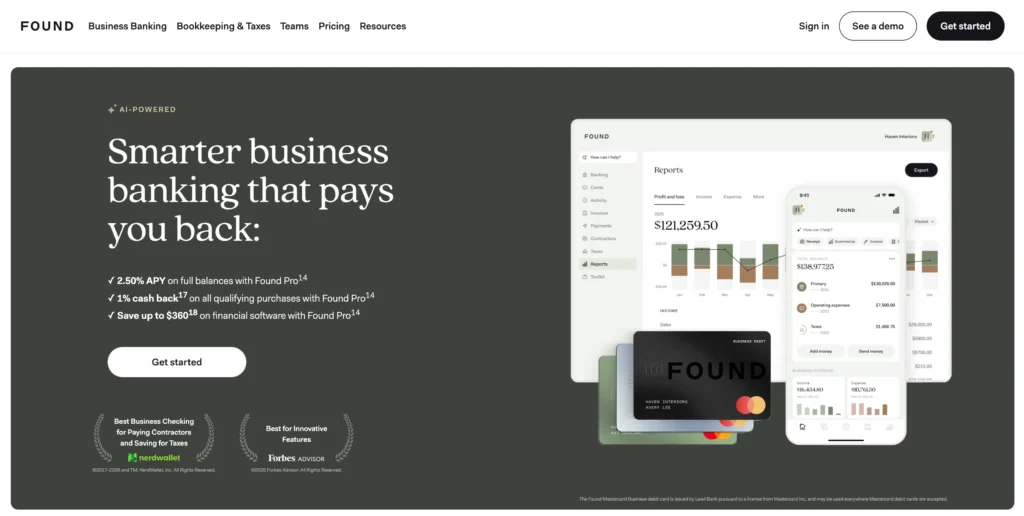
Found is designed around the problems self-employed owners face after receiving a payment: categorizing the income, recording expenses, and reserving enough for taxes.
Its free account has:
- No required monthly maintenance fee
- No minimum balance
- Free ACH transfers
- Expense categorization
- Profit-and-loss reports
- Invoicing
- Automatic tax withholding from deposits
- A running estimated tax bill
- Schedule C reporting tools
Banking services are provided by Lead Bank, Member FDIC, with deposits insured up to the applicable $250,000 limit per ownership category.
How the tax feature can help
Suppose your LLC receives $8,000 in monthly customer payments and you decide to reserve 25% for federal and state taxes.
Found can help allocate:
$8,000 × 25% = $2,000
That leaves $6,000 visible for business expenses and owner withdrawals rather than allowing the full $8,000 to appear spendable.
This feature is particularly useful for a single-member LLC taxed under the default Schedule C treatment. An LLC that elects S corporation taxation will have payroll and separate return requirements that go beyond Schedule C-focused automation.
Fees to watch
Found’s basic account has no opening, overdraft, or minimum-balance fee, but certain services cost extra. Cash deposits currently cost $2, standard outgoing wires cost $15, and optional Found Plus and Pro subscriptions cost $35 and $80 per month, respectively.
Why it matters: Found can reduce the number of separate apps a solo business owner uses. Its strongest value is organization, not branch banking or frequent wires.
4. Mercury Business Banking: Best for Startups and Wire Transfers
Mercury is built for technology companies, online businesses, and startups that move money digitally.
Its core business banking currently offers:
- Free checking and savings accounts
- No monthly, opening, minimum-balance, or overdraft fees
- Free standard ACH transfers
- Free domestic wires
- Free international wires sent in U.S. dollars
- Virtual and physical cards
- Recurring payments
- User permissions and approval controls
Mercury is a fintech company, not an FDIC-insured bank. Banking services are provided through Choice Financial Group and Column N.A., both FDIC members, along with applicable sweep networks.
Where the savings can become meaningful
Assume your LLC sends eight domestic wires per month. If another account charged a hypothetical $15 for each wire, the monthly cost would be:
8 × $15 = $120
Mercury’s free domestic wires could eliminate that expense. The same logic applies to a U.S. startup paying overseas contractors through U.S.-dollar wires.
The account also works well when a bookkeeper, operations manager, or contractor needs limited access. You can issue cards and set permissions without sharing the owner’s login.
The main limitation
Mercury does not provide physical branches or support cash deposits, making it a poor match for restaurants, retailers, and other cash-heavy businesses. Some advanced workflows require a paid plan starting at $35 per month, and non-U.S.-dollar wires involve foreign-exchange costs.
Why it matters: Mercury is excellent for digital-first companies with ACH and wire activity. Its features are less valuable when the LLC mainly collects cash or needs face-to-face banking.
5. Relay Business Banking: Best for Multiple Accounts and Cash-Flow Organization
Relay is a strong choice for a single-member LLC owner who wants to divide business income into clearly labeled buckets without opening accounts at several banks.
The free Starter plan currently provides:
- No monthly subscription fee
- Up to 20 checking accounts per business
- Physical and virtual debit cards
- Automated transfers based on percentages or fixed amounts
- Direct integrations with QuickBooks Online and Xero
- Role-based access for accountants and bookkeepers
- Savings accounts earning 1.11% APY as of May 2026
Relay is a financial technology company rather than a bank. Banking services are provided by Thread Bank, Member FDIC. Eligible deposits may receive up to $3 million in pass-through FDIC coverage through a deposit sweep program when applicable conditions are satisfied.
How a solo LLC owner could use 20 accounts
Suppose your LLC receives $12,000 in monthly revenue. You could automatically divide each deposit as follows:
- Operating expenses: 45%, or $5,400
- Owner’s compensation: 25%, or $3,000
- Taxes: 20%, or $2,400
- Profit reserve: 5%, or $600
- Equipment and annual expenses: 5%, or $600
The money remains separated before it can accidentally be spent.
This structure is especially useful for owners following a bucket-based cash-management system. Instead of checking a spreadsheet to determine whether you can afford a purchase, you can look directly at the relevant account balance.
Relay also offers paid Grow and Scale plans. Grow currently costs $30 per month, while Scale is advertised at a discounted $90 per month. The higher tiers provide stronger savings rates and additional automation, but most new single-member LLCs should start with the free plan and upgrade only when the added features save more than the subscription cost.
The main limitation
Relay has no traditional branch network. Cash deposits are possible through supported services, but the account is built primarily for businesses receiving money through ACH, checks, wires, and payment processors.
Why it matters: Relay turns the bank account itself into a cash-flow system. That can be more useful than a small interest bonus for an owner who regularly forgets to reserve money for taxes or annual bills.
6. Novo Business Checking: Best for Freelancers and Online Businesses
Novo is designed for independent businesses that receive digital payments, send invoices, and use several online business platforms.
Its business checking account currently includes:
- No monthly maintenance fee
- No minimum balance
- No transaction limits
- Free standard ACH transfers
- Free incoming wires
- Built-in invoicing and payment tracking
- Expense categorization
- Integrations with more than 40 business tools
- Up to 20 Novo Reserves
Novo is a fintech company. Banking services are provided by Middlesex Federal Savings, F.A., Member FDIC, with deposits insured through the partner bank up to the applicable $250,000 limit.
Why Novo Reserves are useful
Novo Reserves are budgeting buckets inside the main checking account rather than separate bank accounts. You can automatically allocate a percentage or fixed amount from incoming deposits without paying transfer fees.
Suppose a freelance designer receives a $5,000 client payment and uses these allocation rules:
- Taxes: 25%, or $1,250
- Software and subscriptions: 10%, or $500
- Owner’s pay: 50%, or $2,500
- Business reserve: 15%, or $750
The full $5,000 does not remain visible as freely spendable operating cash.
Novo also connects with tools such as Stripe, Square, Shopify, QuickBooks, and Xero. It reimburses up to $7 in third-party ATM fees each month, which is useful for occasional withdrawals but less attractive for owners who regularly use out-of-network machines.
The main limitation
Novo is not built for businesses that routinely deposit cash or require in-person banking. Domestic outgoing wires and faster transfer services may also involve additional costs, so owners should review the fee schedule based on how they move money.
Why it matters: Novo works particularly well when the owner’s business already operates through invoices, e-commerce platforms, payment processors, and accounting software.
7. Axos Basic Business Checking: Best for ATM Reimbursements and Incoming Wires
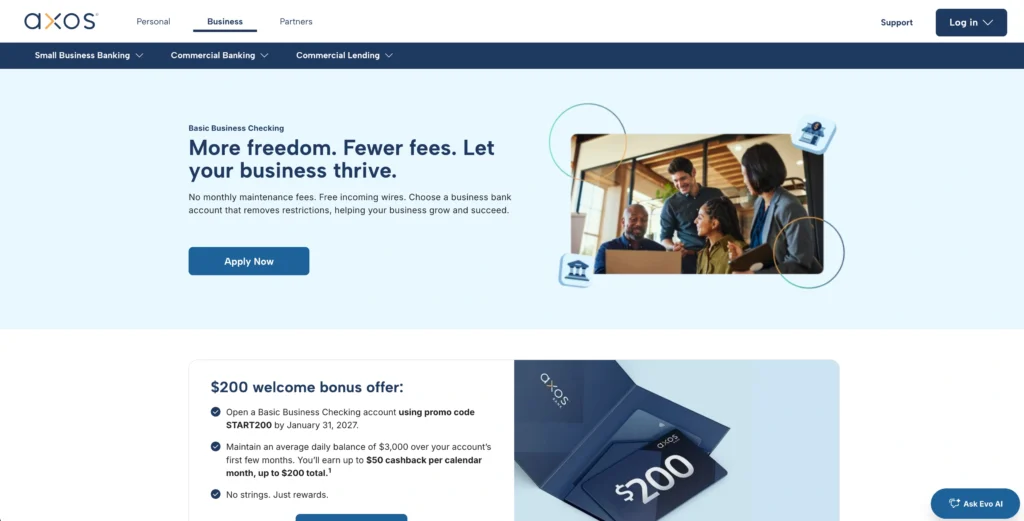
Axos differs from several accounts in this ranking because Axos Bank is an FDIC-insured bank rather than a fintech interface using a partner bank.
Basic Business Checking currently offers:
- No monthly maintenance fee
- No minimum opening deposit
- No ongoing minimum balance
- Unlimited transactions
- Unlimited domestic ATM fee reimbursements
- Free domestic and international incoming wires
- Two reimbursed domestic outgoing wires per month
- QuickBooks integration
- FDIC insurance up to the applicable $250,000 limit
Axos also offers an optional insured cash sweep service for businesses that need coverage beyond the standard limit.
Where Axos can save money
Suppose your LLC receives three incoming wires each month. If another bank charged $15 per incoming wire, that would equal:
3 × $15 × 12 months = $540 per year
Free incoming wires could therefore matter more than a modest checking-account APY.
Unlimited domestic ATM reimbursements also make Axos appealing to owners who travel or regularly withdraw cash. Novo’s reimbursement is currently limited to $7 per month, while Axos describes its domestic reimbursement feature as unlimited.
The main limitation
Axos is an online bank without the branch footprint offered by Chase. Basic Business Checking also does not pay interest. Owners maintaining substantial idle cash may want to connect it with an interest-bearing business savings account.
Why it matters: Axos is a practical middle ground for owners who want an actual bank, no monthly maintenance charge, strong ATM access, and favorable incoming-wire treatment.
Comparative Analysis: All Seven Business Accounts at a Glance
| Account | Monthly fee | Best feature | Best for |
|---|---|---|---|
| Bluevine Standard | $0 | Interest-bearing checking | Service and online businesses |
| Chase Business Complete | $15, waivable | Branch and cash access | Local and cash-handling LLCs |
| Found | $0 | Tax and Schedule C tools | Solo owners needing bookkeeping help |
| Mercury | $0 | Free ACH and U.S.-dollar wires | Startups and online companies |
| Relay Starter | $0 | Up to 20 checking accounts | Cash-flow and bucket management |
| Novo | $0 | Invoicing and integrations | Freelancers and e-commerce sellers |
| Axos Basic | $0 | ATM reimbursements and incoming wires | Online businesses needing bank-level access |
The strongest account depends on transaction patterns. Chase may justify its monthly fee for a business depositing cash every week. Mercury can save a digital startup money on wires. Bluevine makes more sense when a large operating balance can earn interest.
How to Open the Account Without Creating Future Problems
Before applying, collect:
- Articles of organization
- EIN confirmation letter, when applicable
- Operating agreement
- Government-issued identification
- Business address
- Ownership and industry details
- Required business licenses
Use the LLC’s exact legal name. Add the trade name only when the account application specifically requests a DBA.
Confirm whether you are opening an account directly with an insured bank or through a fintech. A fintech is not itself FDIC-insured. Pass-through insurance can apply only after funds are placed with an insured bank and the required ownership and recordkeeping conditions are satisfied.
A legally formed LLC’s deposits at the same insured bank are generally combined and insured up to $250,000 in the entity’s business-account ownership category, separately from the owner’s personal accounts.
Common Mistakes to Avoid
- Choosing an account from the welcome bonus alone
- Ignoring wire, cash deposit, and instant-transfer fees
- Opening the account under an incorrect business name
- Continuing to pay personal expenses from the LLC account
- Assuming every fintech is an FDIC-insured bank
- Keeping excess cash in non-interest-bearing checking
- Closing the old account before all payments are redirected
When changing banks, keep the old account open long enough for outstanding checks, subscriptions, customer payments, and automatic withdrawals to clear. Axos recommends allowing roughly 30 to 60 days when redirecting transactions before closing the previous account.
Pro-Tips for Single-Member LLC Owners
Create a dedicated tax bucket immediately. Do not wait until the first quarterly payment is due.
Use the bank feed inside your bookkeeping software. Review and categorize transactions every week rather than reconstructing them at year-end.
Keep a one-month operating buffer. A late client payment should not automatically cause an overdraft.
Review fees using actual activity. Count your monthly wires, cash deposits, ATM withdrawals, and expedited transfers before choosing.
Keep two banking relationships as the business grows. A backup account can help when a debit card is compromised or the primary platform experiences an access problem.
Frequently Asked Questions
1. Does a single-member LLC need a business bank account?
A dedicated account is strongly advisable for maintaining clean records, separating business activity, and presenting the LLC as an independent operation.
2. Can I use my personal checking account for an LLC?
A bank’s terms may restrict business use of personal accounts. Mixing funds also creates bookkeeping, tax, and liability-separation problems.
3. Can a single-member LLC open a bank account without an EIN?
Requirements vary. Some institutions may allow certain eligible single-member LLCs to use the owner’s Social Security number, while others require an EIN.
4. Which business account is best for a freelancer?
Novo and Found are strong choices for freelancers. Novo emphasizes invoices and integrations, while Found provides deeper Schedule C and estimated-tax tools.
5. Which account is best for cash deposits?
Chase Business Complete is the strongest account in this ranking for regular cash handling because it includes branch access and an allowance for in-branch cash deposits.
6. Which business account pays the highest interest?
Rates change. Among the accounts reviewed here, Bluevine pays interest directly on qualifying checking balances, while Relay offers interest through its associated savings accounts.
7. Are Bluevine, Found, Mercury, Relay, and Novo banks?
No. They are fintech companies that provide banking services through FDIC-insured partner banks. Deposit coverage depends on the applicable account structure and insurance conditions.
8. Is FDIC insurance different for an LLC?
A legally formed LLC generally receives separate business-entity deposit coverage at an insured bank, up to the applicable limit, apart from the owner’s individually held deposits.
9. Can I open more than one business bank account?
Yes. Multiple accounts can help separate taxes, operating expenses, reserves, and owner distributions. Relay is particularly useful for this purpose.
10. Can I change business banks later?
Yes. Redirect customer payments, payroll, tax withdrawals, cards, subscriptions, and outstanding checks before closing the original account.
Conclusion
A single-member LLC does not need the most complicated bank account. It needs one that keeps records clean, accepts customer payments efficiently, and does not charge for features the owner rarely uses.
Start by reviewing how your LLC receives money. Then count the transactions that may carry fees. Only after that should you compare interest rates, bonuses, and extra tools.
Final Verdict
Bluevine is the best overall choice for many single-member LLCs because it combines no standard monthly fee, unlimited transactions, subaccounts, and interest on qualifying balances.
Chase is the stronger choice for cash deposits and branch service. Found is best for tax organization. Mercury suits wire-heavy startups. Relay provides the most flexible cash-flow buckets. Novo fits freelancers and online sellers, while Axos offers a strong no-fee account directly from an FDIC-insured online bank.
The right account is the one that saves time and money during ordinary business weeks, not merely on the day you open it.